
• Skip to primary navigation
  • Skip to main content
  • Skip to primary sidebar

CooksInfo

  • Home
  • Encyclopaedia
  • Kitchenware
  • Recipes
  • Food Calendar
menu icon
go to homepage
search icon
Homepage link
  • Recipes
  • Encyclopaedia
  • Kitchenware
  • Food Calendar
×
Home » Fruit » Exotic Fruit » Mangosteen

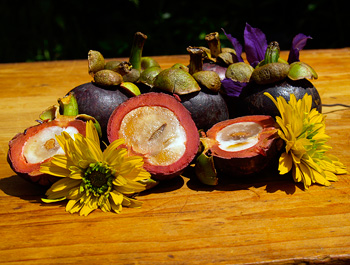
Mangosteen

MangosteenMangosteen
© Denzil Green
Contents hide
  • 1 Cooking Tips
  • 2 Sources

The Mangosteen tree is a tropical evergreen that grows 10 to 25 metres tall (3 to 7.5 metres.) The tree is slow growing: it needs 10 years of growth before it can start to produce fruit, but when it starts, it can often produce two crops a year.

The leaves grow up to 10 inches long (25 cm.)

The Mangosteen fruit is round and flattened at both ends. One end of the fruit will have a scar where the flower was, opposite to the stem end. The fruit will be 2 ¼ to 2 ¾ inches (6 to 7 cm) wide with a thick, hard pale-green rind that ripens to a dark purply-red or purple-brown colour. Inside, the flesh is cream-coloured with only a few seeds: generally just 1 to 2 seeds per fruit. The flesh will be divided into 4 to 8 segments: the number of segments will always equal the number of flower parts contained in the scar at the bottom.

The taste is sweet with a bit of tartness. Some liken it to a combination of peaches and lychees; others think it reminds them of fresh plums.

The fruit will not ripen any further once picked.

Fresh Mangosteen has been outlawed in America [1] owing to fear of pests that might hitch a ride on them (as of 2006.) It is now being grown on Hawaii, with plans to irradiate it according to United States Department of Agriculture (USDA) standards so that it can be shipped to the mainland.

It is not related to the mango at all.

Cooking Tips

The skin and seeds are inedible.

Cut it open to get at the segments which separate from each other easily. The amount of edible flesh in one isn’t actually a lot.

Can be eaten fresh out of hand, or used to make juice or jam from.

Nutrition Facts

Per 100 g (3.5 oz)

Amount
Calories
34
Carbohydrate
5.6 g
Protein
.6 g
Vitamin C
4.2 mg
Calcium
7 mg
Potassium
19 mg

Sources

[1] Mintz, Jessica. Finding a forbidden fruit in Chinatown. New York, New York. Downtown Express. 21 October 2003. Retrieved July 2010 from http://www.downtownexpress.com/de_26/findingaforbidden.html

Other names

Scientific Name: Garcinia mangostana
French: Mangoustan

This page first published: Nov 16, 2003 · Updated: Jun 18, 2018.

This web site generates income from affiliated links and ads at no cost to you to fund continued research · Information on this site is Copyright © 2026· Feel free to cite correctly, but copying whole pages for your website is content theft and will be DCMA'd.

Primary Sidebar

Hi, I'm Skylar! This is a fake profile talking about how I switched to a paleo diet and it helped my eczema and I grew 4". Trust me, I'm an online doctor.

More about me →

Popular

  • E.D. Smith Pumpkin Purée
    E.D. Smith recipe for pumpkin pie
  • Libby's Pumpkin Pie
    Libby’s recipe for pumpkin pie
  • Pie crust
    Pie Crust Recipe
  • Smokey Maple Pepper Glaze for Ham
    Smokey Maple Pepper Glaze for Ham

You can duplicate your homepage's trending recipes section in the sidebar to reinforce the internal linking.

We no longer recommend using a search bar, newsletter form or category drop-down menu in the sidebar. See the Modern Sidebar post for details.

If the block editor is not narrower than usual, simply save the page and refresh it.

Search

    Today is

  • World Tuna Day
    Tuna fish
  • Truffles Day
    Truffle

Footer

↑ back to top

About

  • About this site
  • Privacy Policy
  • Copyright enforced!
  • Terms & Conditions

Newsletter

  • Sign Up! for emails and updates

Site

  • Recipes
  • Encyclopaedia
  • Kitchenware
  • Food Calendar

This web site generates income from affiliated links and ads at no cost to you to fund continued research · The text on this site is © Copyright.