
• Skip to primary navigation
  • Skip to main content
  • Skip to primary sidebar

CooksInfo

  • Home
  • Encyclopaedia
  • Kitchenware
  • Recipes
  • Food Calendar
menu icon
go to homepage
search icon
Homepage link
  • Recipes
  • Encyclopaedia
  • Kitchenware
  • Food Calendar
×
Home » Vegetables » Leafy Vegetables » Potherbs » Samphire

Samphire

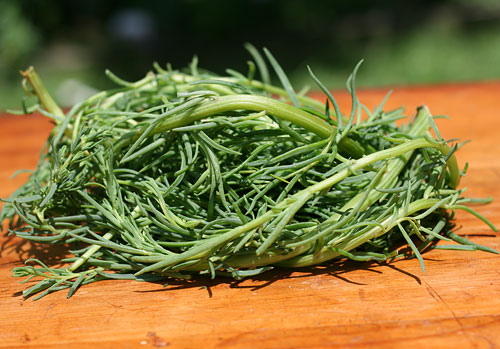
SamphireSamphire
© Denzil Green
Contents hide
  • 1 Cooking Tips
  • 2 Literature & Lore
  • 3 Language Notes

Samphire is a bright green marsh plant that grows on rocks by the sea. It’s a perennial that grows in clumps and bunches up to 60 cm (2 feet) tall.

Some people think of it as a pot-herb; some think of it as a vegetable.

It does have leaves, but they are more like bright green, fleshy stems. Harvest them young, before the plant flowers.

It grows on coasts in Europe, including Southern Europe, but rarely as far as up into Scotland. It is often found in very muddy ground by the seashore, where the tide washes up.

It also grows on the east coast of Canada in areas such as Nova Scotia and New Brunswick. Acadians in this area consider it a local delicacy and call it “tétines de souris” (“mouse nipples”.)

Samphire is not the same as rock samphire in the Mediterranean, which is a shrub that grows on cliffs.

Cooking Tips
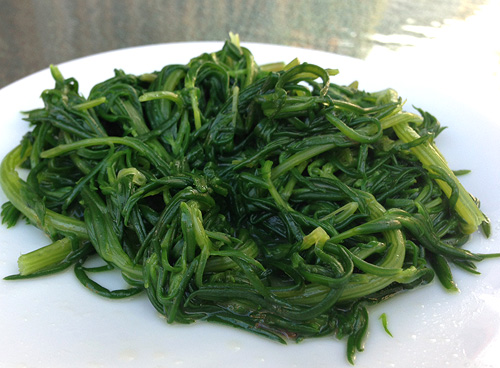
Cooked Samphire

Cooked Samphire
© Michelle Mattern

Samphire can be eaten fresh, pickled to preserve it, or cooked and served as you would asparagus.

To cook it, wash well to get rid of any sand. Bring water to the boil. Don’t add any salt to water – it already has a salty flavour. Simmer until tender, about 10 minutes. Serve with melted butter, or with ground pepper and vinegar.

Literature & Lore

“Half-way down hangs one that gathers samphire; dreadful trade!” — King Lear, Shakespeare.

Language Notes

Though one of the other English name’s is “Sea Fennel”, as is the German name “Meerfenchel”, Samphire is not at all related to fennel. People in North Norfolk pronounce samphire as “samfer.”

One of its synonyms, Glasswort, comes from its being used in the past in making soda glass.

Also called samphire greens, beach asparagus, sea asparagus, crow’s foot greens, sea beans, sea pickle, salicornes.

Other names

AKA: Glasswort, Poor Man's Asparagus, Rock Samphire, Sea Fennel, Sea Lavender
Scientific Name: Salicornia europaea
Latin: Crethmos
Italian: Herba di San Pietra, Sanpetra
French: Salicorne, Tétines de souris
German: Meerfenchel
Dutch: Zeekraal
Spanish: Hinojo marino, Perejil marino

This page first published: Jan 9, 2004 · Updated: Oct 4, 2020.

This web site generates income from affiliated links and ads at no cost to you to fund continued research · Information on this site is Copyright © 2026· Feel free to cite correctly, but copying whole pages for your website is content theft and will be DCMA'd.

Tagged With: Acadian Food, British Food

Primary Sidebar

Hi, I'm Skylar! This is a fake profile talking about how I switched to a paleo diet and it helped my eczema and I grew 4". Trust me, I'm an online doctor.

More about me →

Popular

  • E.D. Smith Pumpkin Purée
    E.D. Smith recipe for pumpkin pie
  • Libby's Pumpkin Pie
    Libby’s recipe for pumpkin pie
  • Pie crust
    Pie Crust Recipe
  • Smokey Maple Pepper Glaze for Ham
    Smokey Maple Pepper Glaze for Ham

You can duplicate your homepage's trending recipes section in the sidebar to reinforce the internal linking.

We no longer recommend using a search bar, newsletter form or category drop-down menu in the sidebar. See the Modern Sidebar post for details.

If the block editor is not narrower than usual, simply save the page and refresh it.

Search

    Today is

  • First Care Packages
    CARE package being shown to officials in Paris
  • Eat What You Want Day
    Buffet

Footer

↑ back to top

About

  • About this site
  • Privacy Policy
  • Copyright enforced!
  • Terms & Conditions

Newsletter

  • Sign Up! for emails and updates

Site

  • Recipes
  • Encyclopaedia
  • Kitchenware
  • Food Calendar

This web site generates income from affiliated links and ads at no cost to you to fund continued research · The text on this site is © Copyright.