
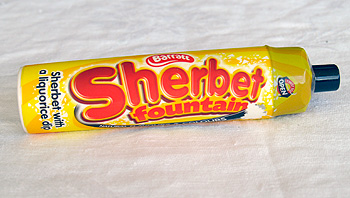
 Tube of Sherbet Candy Powder
© Denzil Green
In the United Kingdom, the word “Sherbet” means a candy powder that is both sweet and tart at the same time. The powder also fizzes when it comes into contact with water, such as the moisture in your mouth.
To make it, you need a dry acid for the sourness, sugar for the sweetness and an alkali to react with the acid (all ingredients must be dry.)
If you were to make it yourself at home, you would likely use cream of tartar, or powdered citric acid. You would then add sugar for sweetness, and some baking soda. When the baking soda and the acid get wet, they react together (being an alkali and an acid.) As they react, they first combine, then breakdown to form sodium citrate plus carbon dioxide. This causes not only the fizz, but also a slight cooling sensation, as the reaction draws heat from your tongue to fuel the reaction.
Commercially, the acid in it to provide the sourness may be citric, malic or cream of tartar. Dry flavourings are usually added as well commercially.
Sherbet is sold on its own, and as a component of other candies (usually the centre of them.) Sherbet Lemons are hard, lemon-flavour candies with sherbet at the centre (these were what Professor Dumbledore in the Harry Potter series was fond of.)
When sold on its own, it may be sold in containers, with or without a straw, or, it may be sealed in a sealed straw.
Cooking Tips
To make your own Sherbet powder, use the following ingredients in the following ratios:
2 teaspoons finely-granulated sugar such as caster sugar or icing sugar
1 teaspoon citric acid (powdered or crystalline)
½ teaspoon baking soda
You can play with the ratio for your own preference.
History Notes
Sherbet started being made in the 1800s. It used to be stirred into a glass of water to make a fizzy drink. This application died out as fizzy soft drinks became available.
Language Notes
Called “Kali” in Northern parts of England, and “Keli” in Scotland.
Sources
Bowers, Simon. Cadbury sells Barratt’s Sherbet Fountain firm for £58m. Manchester: Guardian. 18 January 2008.
Goldstein, Simeon. Media outcry as Sherbet Fountain drops paper for plastic. London: Packaging News. 28 April 2009.
Munk, David. A right Sherbet. Manchester: The Guardian. 27 April 2009.
Reynolds, Mark. Anger Fizzes up over new sherbet tube. London: Daily Express. 28 April 2009.