
Cultivar is short for the phrase “cultivated variety.” It’s a variety of plant that can only maintain its unique characteristics when bred by man. A cultivar will always be named and recognized by horticultural groups; some may even be patented. Apple trees are a good example — though the species as a whole would continue […]
Deipnophobia
Reputedly, this word means a fear of dining in the social sense, and by association, of dinner conversation. The opposite would presumably be something like “Δειπνοσοφιστές” (“deipnosophist”, meaning something like “master of dinner-table conversation”), which is an actual word used by Athenaeus as the title of his book “Δειπνοσοφισταί” (“Deipnosophistae”) written around 228 AD. In […]
Dioecious Plants
Dioecious Plants are plants of which there are both male and female sexes. Both male and female plants may have flowers, but one will have “male” flowers and the other “female” flowers. Some well-known Dioecious Plants include holly, asparagus, dates, mulberry, ginkgo, persmimmons, currant bushes, juniper bushes, sago, and spinach. Some fruit trees also require […]
Docker Holes
Docker Holes are tiny pin holes punched into a commercial biscuit by a machine before baking. The holes allow steam to escape during baking, thus helping to prevent the biscuit from inflating when you are aiming for a flat biscuit. The technique is used in both savory items such as Saltine Crackers, and in sweet […]
Drupes
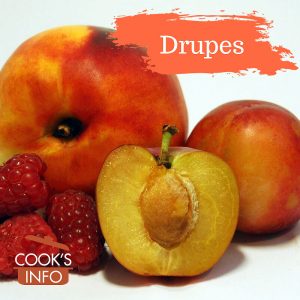
Drupes are fruit with a single, large seed in the middle. The term encompasses fruit seemingly quite different, from peaches to olives to raspberries.
F1
F1 is a term used by plant growers to signify a type of hybrid plant. F1 means the hybrid has resulted from the first generation of the cross between two plants. It’s an intentional cross between two known and compatible cultivars, which brings through desirable characteristics from each while creating a new variety. Every year, […]
Firkin
A Firkin is an old Unit of Measurement. It was equal to ¼ of a barrel, which held 36 imperial gallons. Thus, a Firkin was a volume of 9 Imperial gallons (10.8 US gallons / 40.9 litres.) Language Notes Firkin possibly comes from the Dutch word “vier”, meaning “four.”
Fish Worms
Scientists call Fish Worms “nematodes.” The species involved are usually “Terranova decipiens” or “Porrocaecum decipiens.” They are pests that infest the bodies of fish. This infestation occurs naturally, and can’t be prevented. They are parasites that live in both the stomach and flesh of the fish. They can grow up to 1 ½ inches (4 […]
Gâte-sauce
“Gâte-sauce” is a French term meaning “kitchen help.” It actually means literally a “sauce spoiler.” History Notes The term meant at first a bad cook, then overtime, came to mean young, menial kitchen help, as in a scullery maid or a scullion (a kitchen boy), or a boy employed to turn the spit. Literature & […]
Gomme Arabique
Gomme Arabique is a stabilizer and emulsifier ingredient used in foods, particularly in products such as candies, soda pop, gumdrops, marshmallows, and in some cream cheeses. Gomme Arabique can come from one of two trees. One is the Acacia Senegal, which is propagated from seeds, grows up to 30 feet (9 metres) tall and has […]
Gueridon Service

Gueridon service is a term used in the restaurant business to refer to “trolley service.” Food is cooked, finished or presented to the guest at a table, from a moveable trolley. The classic dishes such as crêpes Suzette, Caesar salad, cherries jubilee, banana flambé and steak tartare were served this way. Gueridon service is less popular now for several reasons. One is that more tables are crammed into restaurant dining rooms now, not allowing enough space between tables for a trolley to move and be positioned
Hock Locks: Turkey leg fasteners
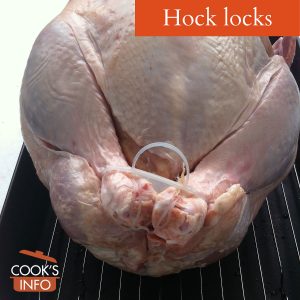
Hock locks are fasteners that come on butchered poultry such as chickens and turkey. They can be made of metal or heat-resistant plastic. You can cook the turkey with them left on, but many people advise to remove them so that the legs will spread out allow the turkey to cook more evenly.
Hybrid
A Hybrid is a generation of plants created by crossing two different but compatible parent varieties. The seed from this generation either doesn’t grow true when planted the next year, or will be sterile. Given the right additional growing inputs — fertilizer, herbicides and pesticides – Hybrids can achieve earlier harvest, greater uniformity or greater […]
Invaiatura
Invaiatura is the beginning of the maturation stage of a fruit. The term is used mostly to refer to olives and grapes. The stage is signalled by the start of a change in colour of the fruit from its unripe colour to its fully ripe colour. The flavour of oil from any given olive can […]
Kosher
Kosher is a Jewish religious term applied to food, meaning prepared or produced and packaged under supervision of a Kosher inspector, called a “meshkiach.” Jewish dietary laws are very closely tied in with their religious laws, which were designed to unite a group of tribes, give them a common identity, and to make them different […]
Lachanophobia
Lachanophobia means “fear of vegetables”. Language Notes This is a modern word, invented from the Greek words “λάχάνον”, meaning “vegetable” (or really anything cultivated in a garden, as opposed to collected from the wild) and φόβος , meaning fear, terror, flight or dismay. As it’s an invented word, there’s nothing to say that you can’t […]
Lime (Chemical)
The chemical lime in the form of Calcium Hydroxide (aka Edible Lime, Hydrated Lime, CaH2O2) is used in some food processing, and has been for millennia.Lime (in the form of Calcium Hydroxide) is used in South America in processing corn. Corn is soaked in water to which Calcium Hydroxide has been added. The corn swells, […]
Lye
Lye is often also called “potash.” It can be made from ashes from burnt wood. It contains potassium carbonate, sodium carbonate and a few other chemicals. Added to water, it makes the water very alkaline. It can be used to process kernels of corn, just as Lime is. Lye in water causes the kernels of […]
Mageirocophobia
Mageirocophobia means “fear of cooking.” The term has been derived from the Greek word “mageirikos”, an adjective meaning “culinary” or “cooking-related.” “Phobia” at the end means “fear of.”
Malic Acid
Malic Acid is found naturally in many unripe fruits, such as unripe grapes and tomatoes. It is what gives green apples and sour cherries a sour, tart taste. It is used on Salt & Vinegar flavored potato chips, and in many artificially fruit-flavoured drinks and baked goods. It is more sour than citric acid. Malolactic […]
Measurements
Cooking is not an exact science. Good food can’t happen in a kitchen without the skills and talent of the cook producing it. Whenever it is reduced to a science that machines can produce without the intervention of a human, you get the kind of food that foodies love to hate — the same foodies […]
Open Pollinated
Open Pollinated is a term applied to plants and seeds. These are the seeds that mankind has used for all of his history, and continues to use. The “open” means pollinated by traditional methods — wind, water and bugs — rather than deliberately in a controlled environment by hand, one plant at a time, as […]
Organic Food
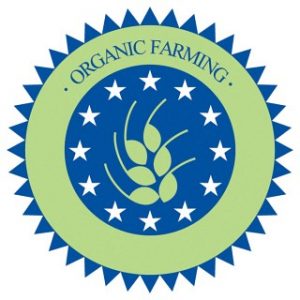
EU Organic Logo © European Commission Organic Food is food that is, ostensibly, grown without manmade aids such as synthetic fertilizers, pesticides or fungicides, and processed with no synthetic additives, colouring or flavouring. Actual legal definition of the word varies wildly from jurisdiction to jurisdiction. In fact, it may be safer to think of it […]
Ostraconophobia
Ostraconophobia is a term meaning “fear of shellfish.” It most cases, it is a dramatic term to mean dislike of shellfish owing to taste, texture, etc. In a few cases where people are allergic to shellfish, it can be a genuine fear of being fed them by mistake.